Does your horse need grain? The honest answer is that it depends, and for most horses the answer is no. Plenty of owners feed grain out of habit, but the majority of horses get everything they need from good-quality pasture or forage. Grain becomes useful only when a horse genuinely cannot meet its energy needs from pasture and hay alone.
This guide explains when grain may be appropriate, how forage should fit into the ration, what types of grain are commonly fed to horses, the risks of overfeeding and how to choose a CowraFeed option that suits your horse’s stage and workload.
In short: Most healthy horses at rest or in light work get all the nutrition they need from forage and do not require grain. Consider grain (or a concentrate feed) for hard-working and performance horses, broodmares, growing youngstock and hard keepers that lose condition on forage alone. Feed changes should be gradual, and the right ration will depend on body condition, workload, forage quality and individual metabolism.
Does Your Horse Need Grain?
Four things decide whether forage alone is enough: workload, life stage, body condition and forage quality. Most horses tick along fine on forage. In fact, a horse holding a healthy body condition on suitable pasture or hay may not need additional grain. If condition is falling, workload has increased, or nutritional demands have changed, a supplementary feed may be worth considering. Grain or a concentrate is worth considering when a horse falls into one of these groups:
- Hard-working and performance horses, such as racehorses, eventers and endurance horses, whose energy needs can be close to double those of a horse at rest.
- Broodmares in late pregnancy and especially during lactation, when nutrient demand climbs sharply.
- Growing youngstock, that need extra energy, protein and minerals for development.
- Hard keepers, senior horses, or horses with limited access to good forage that struggle to hold condition.
- Horses with limited access to suitable pasture or hay.
The most reliable way to judge whether your horse needs more energy is body condition scoring, which rates a horse from 1 (emaciated) to 9 (obese), with 4 to 6 the healthy range. If your horse holds a good score on forage, it almost certainly does not need grain. If your horse is losing condition despite adequate forage, speak with your veterinarian or an equine nutrition professional before making major ration changes.
CowraFeed builds its equine range around exactly these groups, so if your horse sits in one of them there is a ration already formulated for it: Mare & Foal Pellet for broodmares through pregnancy and lactation, Stud Blend for weanlings, yearlings and breeding stock, and Complete Pony Pellet for ponies, spelling horses and anything in light to medium work.
Start With Forage: The Foundation of a Horse’s Diet
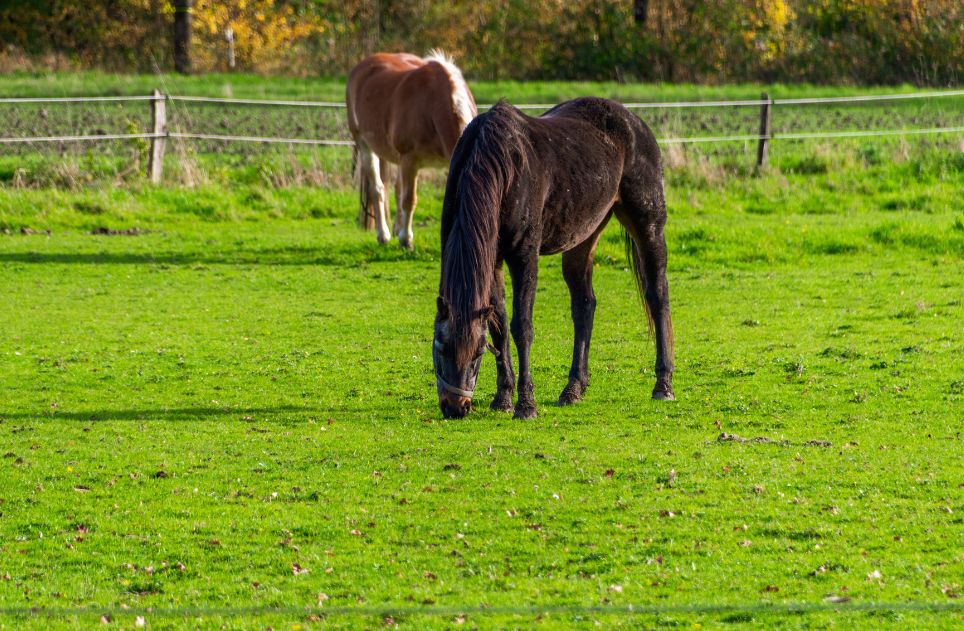
Horses evolved as trickle feeders, grazing low-quality grassland for 16 to 18 hours a day. Their digestive systems are built to process a steady flow of fibre, not big meals of concentrated feed. That biology still drives how they should be fed today.
A healthy adult horse eats roughly 1.5 in total feed each day, and the bulk of that should come from forage. As a rule, a horse needs a minimum of about 1.5% of its body weight in forage daily just to keep its gut working properly. For an idle horse, or one in light work, good pasture or quality hay supplies the energy, protein, fibre and most of the minerals it needs, with no grain required at all.
Why Active Horses May Need Grain
The reason hard-working horses need grain comes down to energy density. A racehorse in full work can require roughly twice the energy of a paddock horse and it simply cannot eat twice as much forage to get there.
Grain solves that problem, however that does not mean every horse in work needs straight grain. It packs more energy into a smaller volume than hay, so it tops up the calories a working horse burns without overloading it with bulk along with providing protein, vitamins and minerals in a formulated ration. It also makes intake easier to measure, so you can match what your horse eats to what it is doing.
How Much Grain Is Safe to Feed a Horse?
Even for horses that need it, grain stays a supplement, not the main event. Forage should always form the base of the diet and the safe amount of supplement depends on the horse’s bodyweight, workload, total ration, the type of grain or concentrate and how much forage is being consumed. Two safety limits matter most:
- Cap the meal size. A horse should never be given more than about 0.5% of its body weight in grain-based concentrate in a single feed. For a 500 kg horse, that is around 2.5 kg per meal. Larger grain meals can exceed the small intestine’s capacity to digest starch, leading it to push undigested starch into the hindgut, where it causes trouble.
- Keep concentrates under half the diet. Feeding more than 50% of the daily ration’s dry-matter weight as high-starch/high-sugar concentrates is associated with increased risk of laminitis, colic and gastric ulcers. Keep forage as the foundation of the diet and use only enough concentrate to meet the horse’s needs.
What Grain can you Feed Horses
Different grains and feed ingredients contribute different amounts of energy, protein, fibre and fat. The best choice depends on what the rest of the ration already provides.
|
Grain |
Role in the diet |
What to consider |
|
A key ingredient in many horse feeds. Similar to oats but harder, so it needs processing to release its nutrients. Lower in fibre than oats, but a good source of energy and protein. |
Processing such as rolling improves accessibility of the grain. |
|
|
The most traditional horse grain and a source of quick-release energy from starch, with around 13% protein plus fibre and B vitamins. Higher in phosphorus, so balance with a calcium source. |
Introduce gradually and balance within the overall ration. |
|
|
Energy-dense, high in starch and around 7 to 12% protein. Lacks several minerals and vitamins, so it works best mixed with other grains or a supplement. |
High in starch, so portion size and ration balance matter. |
|
|
A “super fibre” of slow-release energy, low in sugar and starch, with about 28 to 34% protein. Good for condition and general health. |
Often used as part of a balanced blend or formulated feed. |
|
|
Rich in protein, fats and magnesium and great for coat condition. A cool energy source but keep to a sensible amount (under about 450 g a day). |
Use as part of a balanced ration rather than as the nutritional foundation. |
|
|
High in protein, fibre and potassium, with energy similar to cereal grains. Useful as part of a balanced ration. |
Best used as one component of a balanced ration. |
|
|
Hay |
The foundation of any horse’s diet. Quality varies, but good hay supplies most of the fibre, energy, calcium and vitamins an idle or lightly worked horse needs. |
|
Browse the full equine feed range for straight grains and ready-made mixes.
The Risks of Feeding Too Much Grain
Grain has been fed to horses for generations, but it is not a natural food for them, and it is easy to overdo. When a horse eats more starch than its small intestine can digest, the excess ferments rapidly in the hindgut and turns it acidic. That hindgut acidosis is linked to some of the most serious conditions in horses: laminitis, colic and gastric ulcers.
There is also a mineral balance issue that often gets missed. Cereal grains such as oats, corn and barley are high in phosphorus but low in calcium, and an unbalanced calcium-to-phosphorus ratio weakens bone over time. A horse’s diet should provide roughly 1.5 to 2 parts calcium to 1 part phosphorus, which is why grain is usually balanced with a calcium-rich forage like lucerne (alfalfa) rather than fed on its own.
The practical takeaways: feed little and often, always provide forage alongside or before grain, and introduce any change gradually.
Safer Ways to Add Energy
If a horse needs more condition but you want to avoid the risks of high-starch feeding, grain is not the only option. Two safer energy sources have become standard in modern feeding:
- Fat and oil. Adding vegetable oil or a fat-based supplement is one of the safest ways to lift calories. Fat is a “cool” energy source, meaning it fuels condition and work without the fizzy, excitable behaviour that high-grain diets can cause.
- Super fibres. Highly digestible fibres such as lupins and beet pulp provide slow-release energy without a starch spike. Lupins, at around 28 to 34% protein and very low in sugar and starch, are a good example, which is why many nutritionists rate them as a “super fibre.”
For horses that hold their weight on forage but may fall short on vitamins and trace minerals, a ration balancer is the modern answer. These are concentrated vitamin, mineral and amino acid supplements fed in small amounts, with little starch, sugar or extra calories. They fill the nutritional gaps in a forage diet without the risks of grain and are ideal for easy keepers. To understand how balanced feeds and blends are formulated, see what goes into your feed.
When Grain Can Be Harmful
Some horses should not be fed grain at all without veterinary guidance. Horses and ponies prone to laminitis, or those with equine metabolic syndrome, insulin dysregulation or PPID (Cushing’s), are highly sensitive to the sugars and starches (non-structural carbohydrates, or NSC) in grain and lush pasture. For these horses, a high-starch meal can trigger a laminitis attack.
The safe approach for at-risk horses is a forage-based, low-NSC diet (generally under 10% NSC for high-risk animals) supplemented with a ration balancer, plus careful pasture management and close veterinary input. Easy keepers and many ponies fall into this group and rarely need grain of any kind.
|
Horse / feeding need |
CowraFeed option |
Why it may suit |
|
Spelling, pony club, light to medium work |
Complete Pony Pellet |
Economical supplementary feed formulated for ponies and horses across these stages and workloads. |
|
Pregnancy, lactation and growth stages |
Mare & Foal Pellet |
High-protein supplementary pellet formulated for breeding and growing horses, with feeding rates also provided for different workloads. |
|
Light to medium work / pony club |
Stud Blend |
Muesli-style blend of grains and chaff designed to help keep horses conditioned and cool. |
|
Nervous or excitable horses needing a grain blend |
Cool Horse Blend |
Oat-free grain blend formulated to minimise excitable behaviour. |
Best Practices for Feeding Grain
A few habits keep grain feeding safe and effective:
- Feed by weight, not by scoop. Different grains weigh very different amounts for the same volume, so weigh feeds to know what your horse is really getting.
- Make changes gradually. Introduce any new feed or increase over 7 to 14 days to let the gut adjust and avoid digestive upset.
- Feed little and often. Spread grain across two or three smaller meals rather than one or two large ones, in keeping with the horse’s grazing nature.
- Forage first, always. Keep a consistent supply of pasture or hay, and feed roughage alongside grain (mixing with chaff slows intake and improves digestion).
- Keep water clean and available and stick to a consistent feeding routine.
Need Help Choosing the Right Horse Feed?
The right feed depends on your horse’s workload, life stage, body condition and the pasture or hay already available. Explore the CowraFeed equine range, talk to the CSG Cowra team or find your nearest stockist for help choosing a suitable option.
Frequently Asked Questions
- Do horses really need grain?
Most do not. Healthy horses at rest or in light work get everything they need from forage. Grain helps only when forage cannot meet a horse’s energy needs, such as in hard-working horses, broodmares, growing youngstock or hard keepers. - How much grain can I feed my horse?
There is no single amount for every horse. Keep cereal-grain meals small, make forage the foundation of the diet and follow the feeding directions for formulated feeds. It’s essential to avoid feeding more than around 0.5% of body weight (about 2.5 kg for a 500 kg horse) in a single meal. Forage should always make up the bulk of the ration. - What grain is best for horses?
It depends on the horse and the rest of the ration. Oats, barley and corn are commonly used for energy, while lupins and tic beans can contribute protein and energy. A formulated feed may be easier when you also need vitamins and minerals balanced into the ration. - Can too much grain hurt my horse?
Yes. Overfeeding grain pushes undigested starch into the hindgut, which can cause laminitis, colic and gastric ulcers. Large grain meals are the main risk, so feed little and often and keep forage as the base. - What can I feed instead of grain for extra energy?
Depending on the horse, fat sources and highly digestible fibre can increase energy intake without relying on large cereal-grain meals. If your horse is losing condition unexpectedly, investigate the cause with your veterinarian. - Which horses should not be fed grain?
Horses and ponies prone to laminitis, or with metabolic conditions like equine metabolic syndrome, insulin dysregulation or PPID, should avoid grain and high-sugar feeds. They do best on a forage-based, low-NSC diet with a ration balancer and veterinary guidance.
References & Useful Articles
- What horses eat that keep them healthy | The Spruce Pets, Vet Reviewed & Pet Approved
- Does a Horse Need Grain? | Horse Racing Sense
- Does a horse need grain? | Helpful Horse Hints
- Think Energy When Feeding the Racehorse | Kentucky Equine Research, Equinews
- Feeding Thoroughbred Racehorse | Virbac Australia
- They Are What They Eat: Building Blocks of Thoroughbred Nutrition | Paulick Report
- Lupins for Horses Explained | CEN Nutrition
- Oats for Horses – The Pros and Cons | CEN Nutrition
- Feeding Barley to Horses | Prohorse